 Chiro Lab
*This post is the blog version of the review video above. (The video is in Japanese.)
Thank you, SIGMA.
A grateful review of the 20-200mm F3.5-6.3 DG Contemporary
The Sigma 20-200mm F3.5-6.3.
A high-magnification zoom that covers everything from 20mm wide-angle to 200mm telephoto in one lens.
If you have found this page, you have probably already researched this lens quite a bit. I'll leave the overview to other sites. On this page I've put together its resolution, its shooting magnification, and how its F-number changes. It's probably best described as a reference page for people who already own this lens.
1. Resolution: the sweet spot is in an unexpected place
For the test, I took 4K 60p Long GOP footage shot in daylight outdoors, pulled out still frames, and analyzed them with Imatest.
Because I was working with compressed footage, the results are only relative... I thought about reshooting in All-Intra, but decided it was fine for seeing the trend. (I've often given up on making a video altogether because it became too much work, so 🙏...)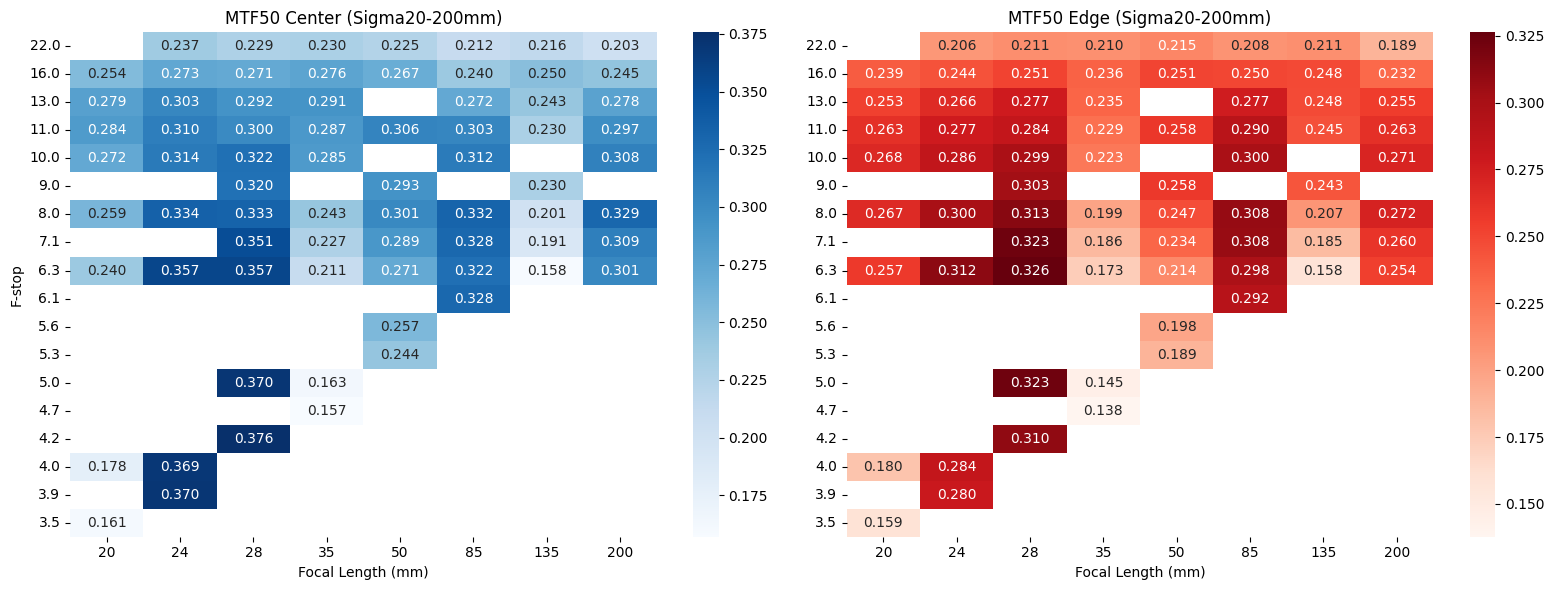
When I turned the results into a heatmap, the resolution was high around 24-28mm, at 85mm, and at 200mm.
The horizontal axis is the focal length, the vertical axis is the F-number, and the darker each square is, the higher the resolution. The blue graph on the left is the center of the lens, and the orange graph on the right is the edge of the lens.
A lens resolves best at the center, meaning it renders fine detail best there, so the center always scores higher than the edge, and this lens is no exception. You may have seen the praise "it resolves all the way to the edges" in lens reviews. With poor-quality older lenses, only the center was good, and the edges were so soft that you couldn't tell whether it was blur or poor resolution.
At 24-28mm in particular, the lens was sharp from wide open, and it showed the curious trait of getting slightly worse as I stopped down. Had I made a mistake in how I shot? Did sunlight affect it? I wondered, but the trend was consistent at each focal length, so I decided to publish it as it's. (I excluded extremely high or low outliers from the analysis.)
On the other hand, there are clear dips at 35mm and 135mm, which may be due to the aberration correction in the design or how the internal lens groups move.
I'd assumed that the telephoto end of an all-in-one zoom tends to be soft, but I think this lens is good enough for practical use even at 200mm.
You can use it wide open with confidence, with the solid rendering that's typical of SIGMA.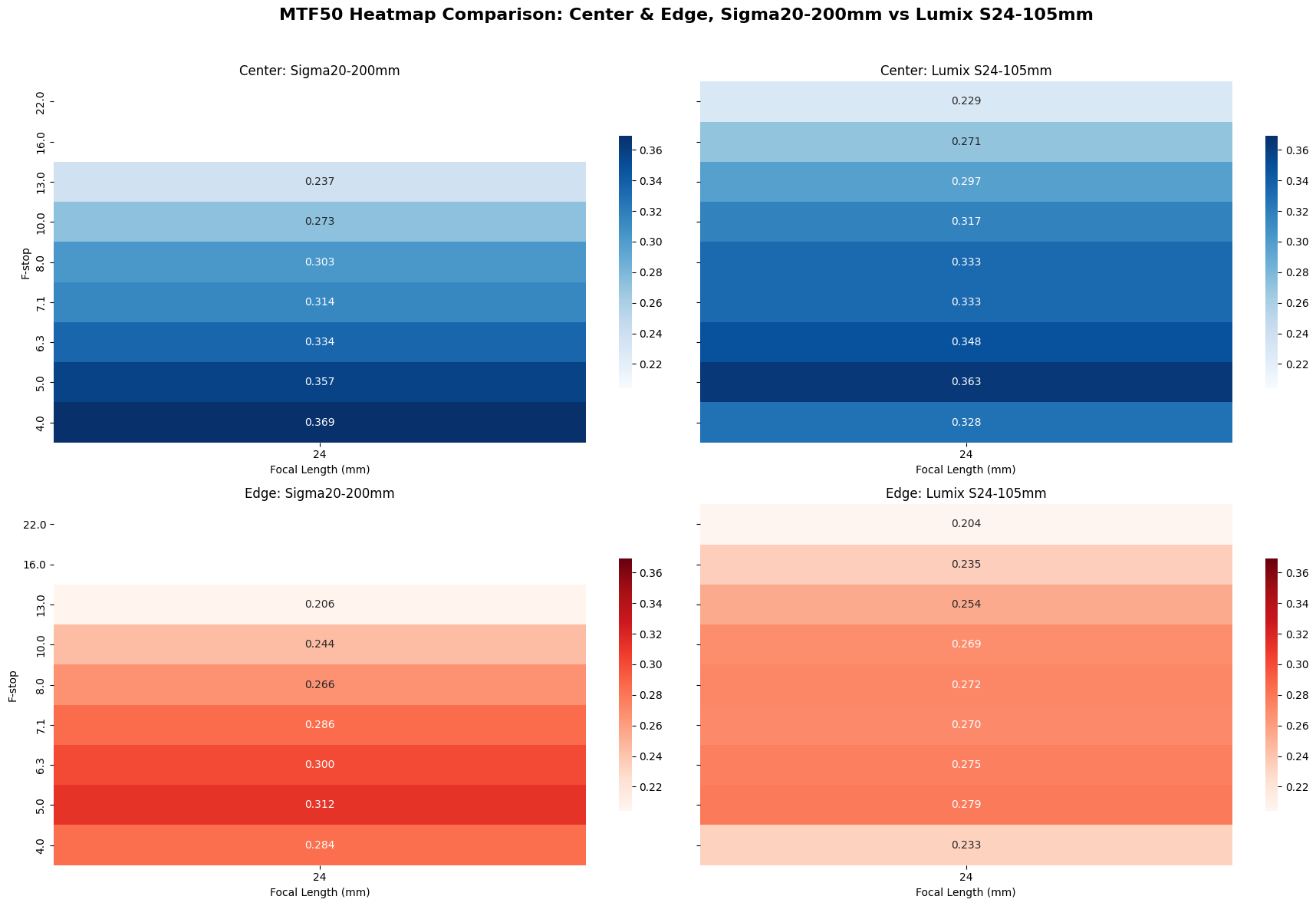
↑ This is the comparison with the Lumix S 24-105mm, both at 24mm.
Sigma is on the left and Lumix is on the right.
The Lumix also seems to resolve best at F5.6... I wonder why 🥺
In my YouTube video I said Sigma looked better, but the Lumix also looks like it delivers consistently good resolution. It's hard to pick a winner.
In that case, it's surprising that the Sigma 20-200mm achieves this resolution even though its zoom range is wider.
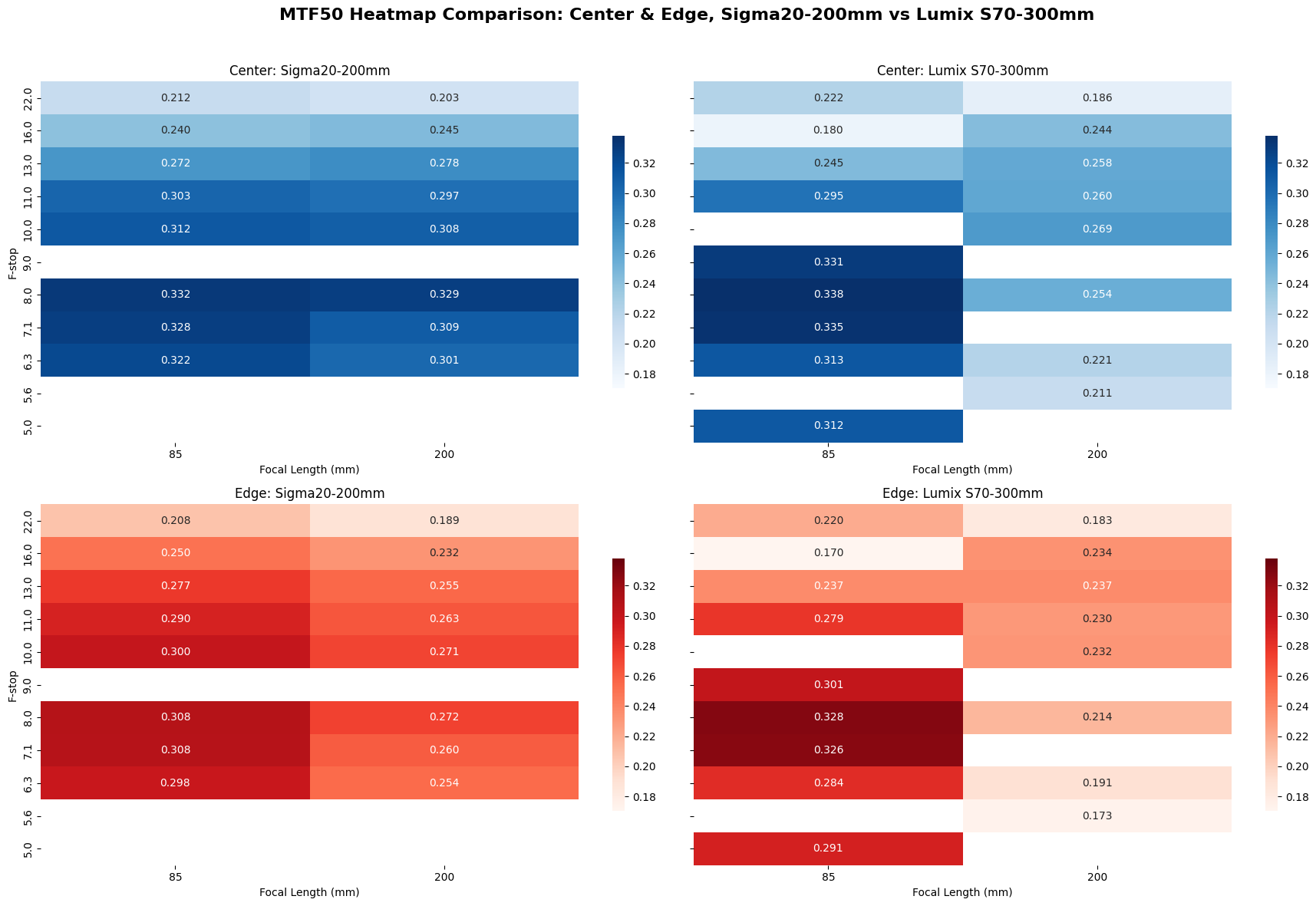
↑ And this is the comparison with the Lumix S 70-300mm.
Sigma is on the left and Lumix is on the right. I compared 85mm and 200mm.
Overall, the Sigma seems to resolve better. Maybe the Lumix 70-300 doesn't resolve very well...?
However, my hypothesis is that 85mm and 200mm are awkward middle focal lengths for the Lumix 70-300mm, which is why the resolution drops. I don't know what design philosophy the 70-300mm follows, but measuring resolution at finer steps of focal length might tell.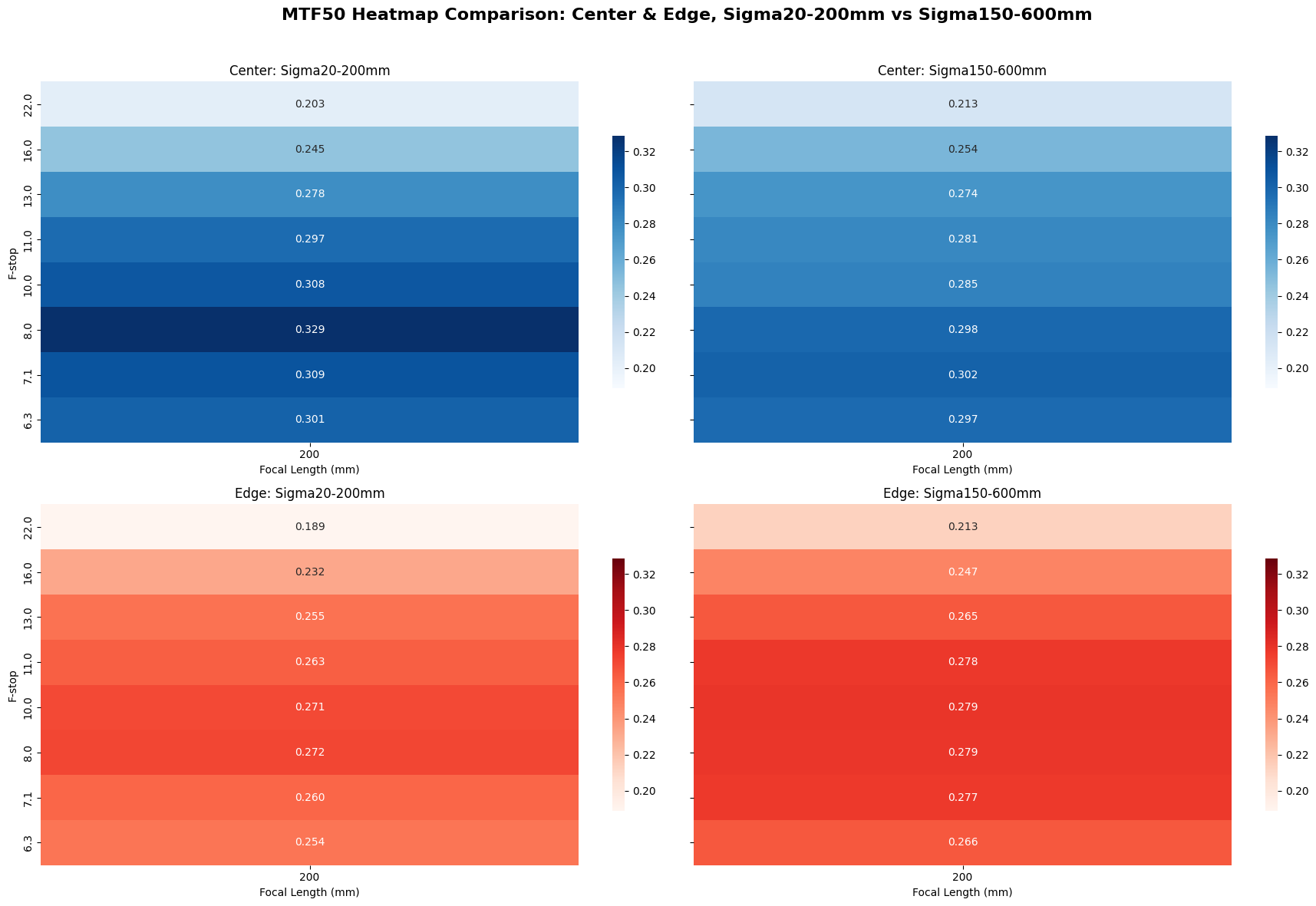
↑ This is the comparison with the Sigma 150-600mm.
The 20-200mm is stronger in the center, but the 150-600mm looks better at the edges.
I suspect that 200mm is also an awkward focal length for it, which might explain this result, but I can't say anything definite. Comparing both at 150mm might have given a different result.
If many people ask for it, I'd like to test that.
2. Changes in F-number: a curve that drops sharply in the first half
This lens has a variable maximum aperture of F3.5-6.3.
I assumed the F-number would rise gently as you zoom from 20mm to 200mm, but when I measured it, the F-number rises quickly in the first half.
It reaches about F6.1 around 85mm, and stays almost flat after that.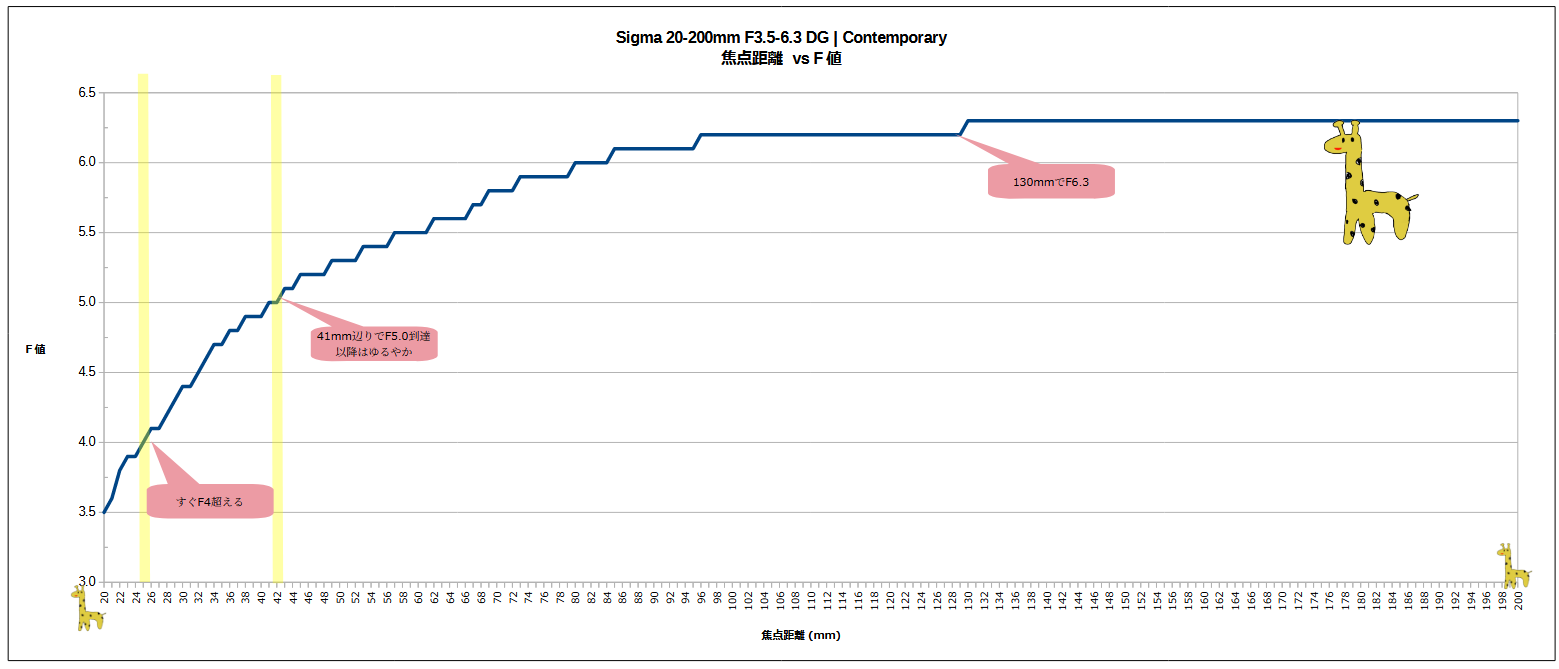
The horizontal axis is the focal length and the vertical axis is the F-number.
I do feel "I wish it had held on a bit longer",
but it makes sense when you consider that this is the result of balancing light weight and price.
It goes from F3.5 at 20mm to over F4 at 25mm, so I think you need to be a little careful when shooting video where you want to set the exposure precisely.
Still, for a 10x zoom, this brightness is a minimal price to pay.
I think the convenience of being able to carry it around is exactly the design philosophy of this lens.
Still, my impression is that at night it's a bit tough even indoors with a light source.
3. Close-focus performance: a macro lens in an all-in-one zoom's clothing
The maximum magnification is 0.5x.
However, that's only between the focal lengths of 28mm and 85mm.
When I measured the minimum focusing distance, it was about 23cm at 20mm, the shortest distance was recorded at 28mm, and from 85mm on the shooting distance gradually grows. (Naturally.)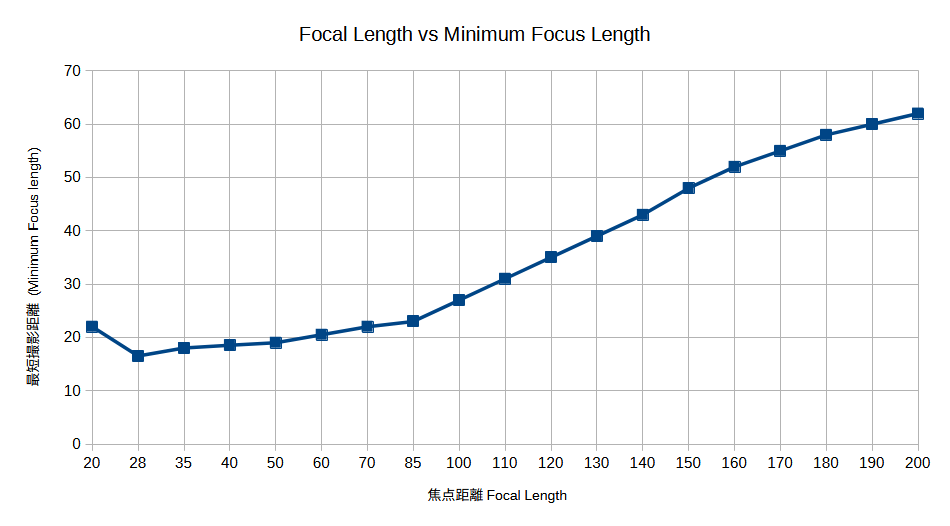
For comparison, the TAMRON 28-200mm is 0.32x,
and the same company's 50-400mm reaches 0.5x only at the wide end.
Lenses such as the Lumix 24-105mm Macro O.I.S. also reach 0.5x, but only at some focal lengths.
Also, among Leica L-mount all-in-one zooms there are few competitors, and I think you can fairly say the Sigma 20-200mm has the field almost to itself.
In actual shooting, there were scenes where I could get close enough for the lens hood to touch the subject,
and the convenience of "moving straight into macro shooting in the middle of a standard zoom" was better than I expected.
It's a lens that close-up lovers will not be able to resist. I love getting close.
I also measured the maximum magnification outside 28-85mm, which the official website doesn't publish. The results are below.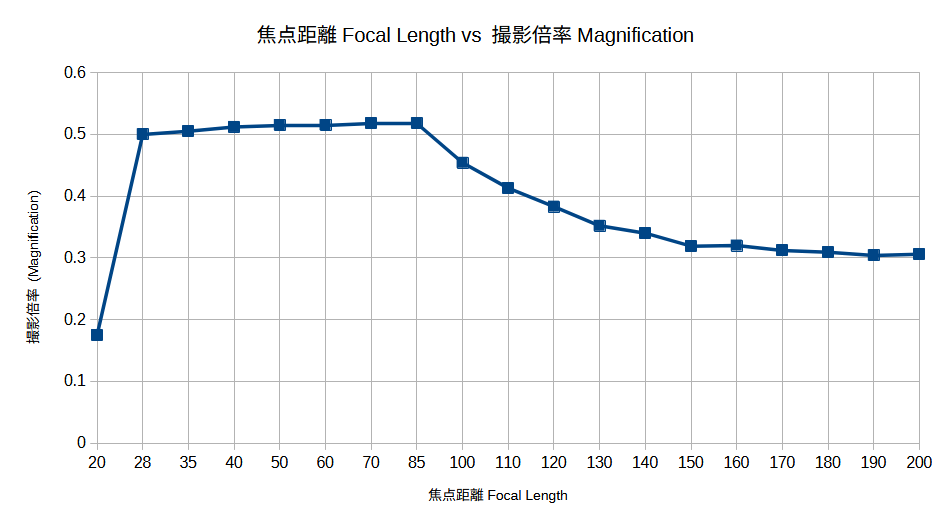
These are relative measurements, assuming 0.5x at 28mm...! Details are in the video.
At the wide end of 20mm, it seems to be below 0.2x.
From 85mm on, the magnification gently decreases and ends up around 0.3x,
so on the telephoto side I'd call it a lens that gets "reasonably close".
4. Portrait performance: soft rendering and quiet bokeh
At 20mm it takes in the surroundings, at 35mm I stopped down a little so the bokeh is restrained,
and at 200mm F7.1 the background melted away pleasantly.
The bokeh is smooth, and neither the foreground nor the background bokeh is noisy.
The autofocus feels natural, and although the lens has no stabilization, it's fully usable for video.
Considering its light weight and the freedom in angle of view, I thought it was ideal for travel, everyday snapshots, and vlog-style portraits.
↑ A damselfly
5. Overall impressions and drawbacks: gratitude and a few flaws
The appeal of this lens is that it's "a serious lens you can take out casually".
Being able to cover 20mm to 200mm with a single lens changes the shooting experience itself.
On casual outings, my other lenses have hardly been used. However, in situations such as having dinner with friends after evening, the high F-number becomes a handicap and tends to force the shutter speed down.
Other drawbacks are as follows.
-
It looks slim but is surprisingly long. It has a big presence when stored.
Even at its shortest length, it's only a little shorter than the Lumix S 24-105 that I own,
so it's fairly long. -
The zoom ring turns the opposite way, which is confusing when you use it together with Lumix or Sony lenses.
Since I started using this lens regularly, I've begun to turn the ring the wrong way when I zoom in a hurry... and this happens even when I'm not using this lens. As long as I use it together with other makers' rings, it looks hard to get used to. -
The torque is heavy, so smooth zooming isn't its strong point.
The lens is bad at slow zooming, so when zooming during video the focal length changes with a jolt. I've used it for over two months and it doesn't seem to be loosening up.
Even so, I think a high-magnification zoom this versatile, this close-focusing and this light is rare.
To SIGMA, who combined resolution, portability and price at such a high level,
I have no words other than "thank you" 🙏
Conclusion
The Sigma 20-200mm F3.5-6.3 is a lens that carries the name "all-in-one zoom" yet changes that image.
It doesn't fall apart at the wide end or the telephoto end, and it has the flexibility to step into macro territory.
I think it matters a lot that this has been realized in the L-mount.
The testing took a great deal of effort, but what I felt through the process was simple gratitude 🙏
With respect to SIGMA, who made a lens that reassures photographers that they don't need to carry another one...
Comments