 Chiro Lab

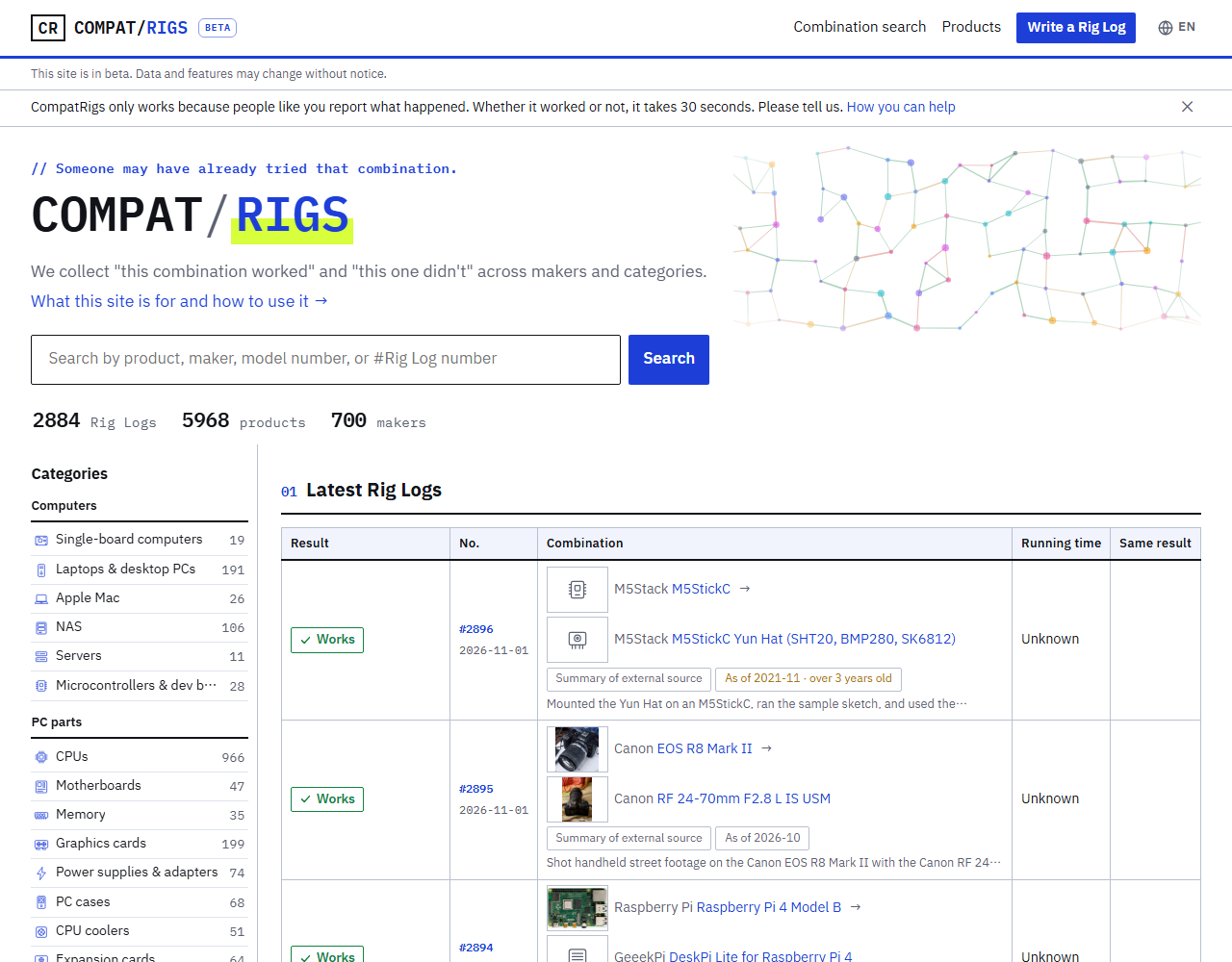
When a device you bought doesn't work in your setup, it hurts, right... Both in time and in money. So I built "CompatRigs", a site that collects real experiences of "this combination worked" and "this one didn't", across makers and categories. This post is about why I made it and what I want to do with it next.
How it started
It started with the NVMe SSD on my Raspberry Pi 5 being detected on some boots and not on others. Whether it showed up changed every time I booted, and at one point the data I thought I was writing to the SSD was actually going to the SD card, until the SD card filled up...
The SSD itself worked fine when I connected it to a PC, so I couldn't tell whether it was the case's adapter, the cable or the Pi 5 itself. In the end I switched to a different adapter board and cable, and it was detected. Now I think the cause was probably the PCIe (FPC) cable.
At the time, I looked for information like "this combination worked", but I couldn't really find a place where it was all collected.
Makers' compatibility lists (QVLs) only cover what that maker tested. For PCIe devices on the Pi there's Jeff Geerling's database, but it's Pi only, and you can't search it by SSD combination. PCPartPicker checks whether parts fit on paper, not whether they actually worked. There was no place that collected reports across makers, per combination, including the "it worked" ones, so I thought I'd try making one.
Can't you just ask AI?
To be honest, there's something I kept thinking while building it. These days AI will answer pretty much anything you ask, so maybe making a blog or a database like this is already a losing game...
But when I actually ask AI "does this SSD work with this adapter?", the answer is usually "please check the maker's official site for compatibility". I think that's all AI can say. For combinations that aren't on the official site, there just isn't much information online to base an answer on, and if AI were held responsible it could turn into a liability issue, so I don't think it can say so clearly.
And shopping site reviews are full of fake ones, so they're hard to rely on, right? Even with rows of five stars, it's hard to find someone using the same combination as you.
So I think real-experience information like "this combination actually worked / didn't" will matter more precisely because we're in the age of AI. In the end, what AI needs to answer is a record of someone who actually tried it. Partly because I couldn't think of any other way, I decided to try being the one who collects that material.
What the site is
On CompatRigs, one record of a combination of devices and whether it worked is called a "Rig Log". You list the devices in the order they connect, like "Raspberry Pi 5 → M.2 adapter → SSD", and choose the result from "works", "works with tweaks", "partially works", "unstable" and "doesn't work".
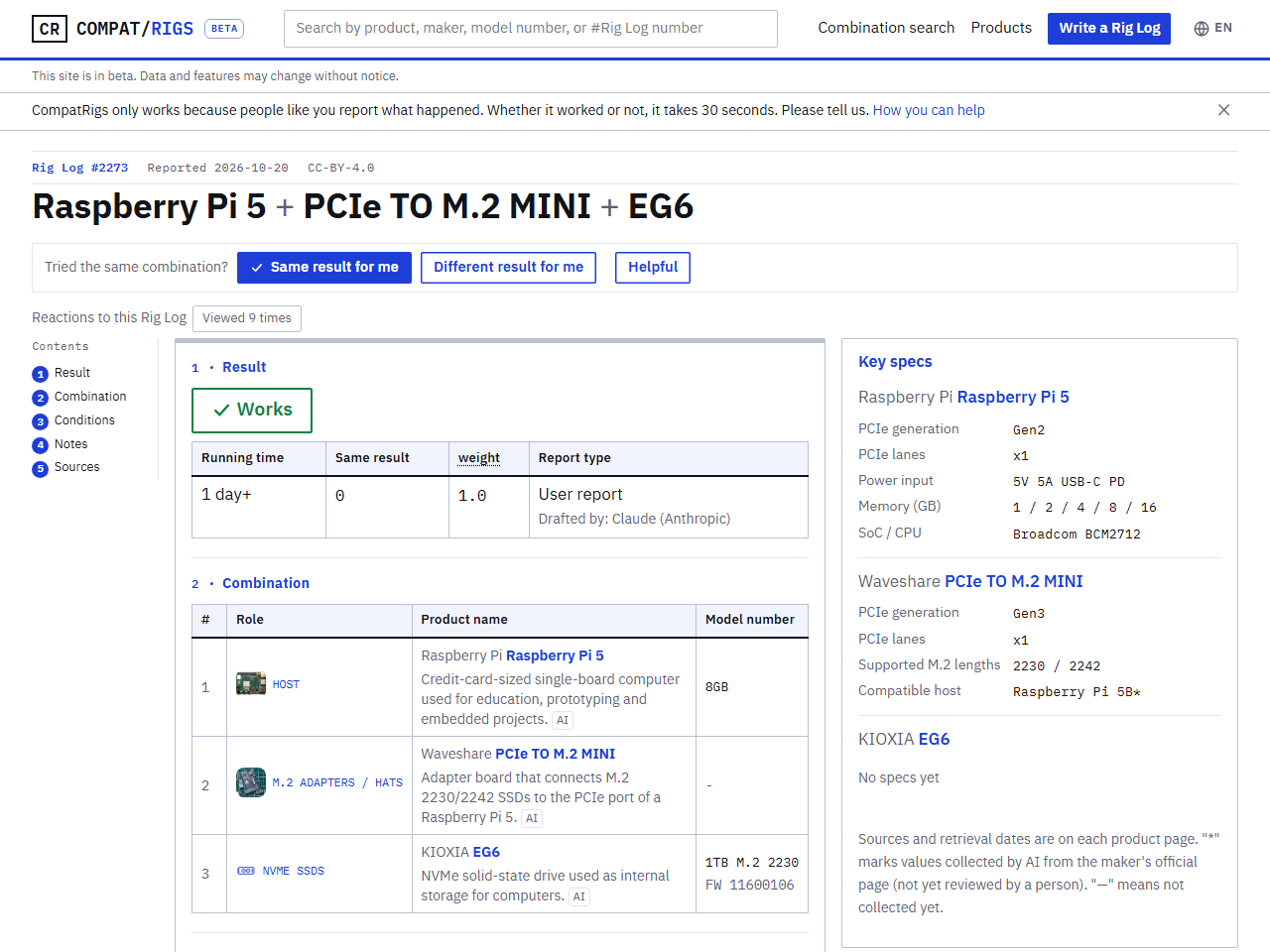
For example, I've logged my own results with a 2230 adapter board (Waveshare PCIe TO M.2 MINI) on a Pi 5 and a KIOXIA EG6 SSD. With PCIe set to Gen2, it was detected on all 10 out of 10 reboots. But with Gen3 it was detected only 6 times out of 10, and the rest of the time it either wasn't detected or failed to mount.
Information like "it works with this setting" or "this SSD didn't work" rarely makes it onto makers' compatibility lists, right?
Here's what I'm careful about.
- Every piece of information has a source. For things picked up from blogs and videos, I link to the original and only include the facts
- "It worked" reports matter just as much as "it didn't work" reports
- Notes estimated from makers' specs (length, M.2 key and so on) look different from reports of actual tests
- The site works in Japanese, English, Chinese, Thai and Russian, because I want to remove the language barrier as much as I can
- I can't guarantee anything works... It's just a collection of individual reports
Right now there are about 2,900 Rig Logs and about 6,000 products (as of November 2026). Most of them, though, are facts picked up from public blogs and articles and posted with their sources, so reports from people who actually used the devices are still to come. Also, a lot of sites say no to bots collecting their information, and I don't collect from those sites.
I've tried to make reporting mostly a matter of picking from lists, and you don't need to log in. If you use the same combination, just pressing "Same result for me" helps a lot.
What I want to do next
First, the main goal is to collect enough information that people think "if you want to check compatibility, go there".
Beyond that, I'm thinking about things like:
- Links to buy a setup that has working reports as is, and showing alternative products with working reports next to ones that "don't work"
- Working with makers, like getting devices for testing or handing out "verified working" badges
- Making the compatibility data usable for AI and online stores
It'd be fun if, when you ask AI, it answered "CompatRigs has N working reports for that".
Also, there are server costs and so on, so I plan to use affiliate links and ads to run the site. But even with money involved, I'll keep showing sources every time, and I won't let ads or maker partnerships change results or their order.
There's a personal motivation too. When I browse AliExpress, there are tons of products from makers I've never heard of, and I'm curious about them. Products like these often don't have any compatibility list from the maker, so I'd like to collect information on whether they actually worked and keep it as my own record too.
It's still in beta and I'm fixing things as I build it, but if you have an experience like "this combination worked!" or "this one didn't...", I'd be really happy if you wrote it up.
*This post was written with the help of AI, but it's based on my own thoughts and experiences.*
Comments